Stirling Engine vs Steam Engine Model: Which Should You Buy?
Stirling or steam? Compare how each working engine model runs, what it needs, how loud and safe it is, and which suits a desk, a classroom or a collector.

Choose a Stirling engine model if you want a quiet, clean engine that runs for a long time on one burner fill and shows how heat alone creates motion. Choose a steam engine model if you want the hiss, the visible steam and the history of the engine that powered the Industrial Revolution, and you are happy to fill a boiler and supervise it closely.
Both are real working engines that run on an alcohol flame, and both make excellent display pieces. They differ in how they work, what they need, and how much attention they ask for. This guide compares them point by point.
How Do Stirling and Steam Engines Differ?
Both engines are external combustion engines: the flame heats the engine from outside and no fuel burns in the cylinder. The difference is the working fluid.
- A steam engine boils water in a boiler. The steam pushes a piston and then escapes into the air, so you have to refill the water. The Wikipedia article on the steam engine describes this cycle in detail.
- A Stirling engine heats and cools the same sealed air over and over. Nothing is used up except the fuel in the burner. Our guide to how a Stirling engine works explains the cycle step by step.
Stirling vs Steam Engine Model: Side-by-Side Comparison
| Stirling engine model | Steam engine model | |
|---|---|---|
| Working fluid | Sealed air | Water boiled into steam |
| Heat source | Alcohol burner | Alcohol burner or spirit lamp |
| Water needed | No | Yes, refill the boiler each run |
| Start-up | Warm up for a minute or two, then spin the flywheel | Wait for the water to boil and build pressure |
| Sound | Near silent, a soft mechanical tick | Hiss and puff of escaping steam |
| Run time | As long as the burner has fuel | Until the boiler water runs low |
| After running | Let it cool | Let it cool, then empty and dry the boiler |
| Hot parts | Hot end of the cylinder, burner | Boiler, steam pipes, cylinder, burner; hot steam |
| Best for showing | Thermodynamics and energy conversion | Steam power and the history of engines |
How Does a Model Steam Engine Work?
Most small steam engines use an oscillating cylinder, sometimes called a “wobbler”. The oscillating cylinder steam engine was proposed by William Murdoch at the end of the 18th century. It needs no valve gear. Instead, the whole cylinder rocks on a pivot as the crank turns, and a hole in the cylinder lines up with steam and exhaust holes in a fixed port block at just the right moments.
This simple, compact design is why oscillating engines are now used mainly in toys and models. It is also easy to understand: you can watch the cylinder rock and see exactly when steam goes in and when it escapes.
The working steam engine model follows this layout. It has a brass cylinder and piston, an aluminium vertical boiler with a safety valve, steam passages built into the base, and a metal spirit lamp in the box.
When Should You Choose a Stirling Engine Model?
- You want an engine that can run quietly on a desk or in an office.
- You teach physics and want to show heat turning into motion, or into electricity with a generator model.
- You prefer less preparation: no water to fill, drain or dry.
- You enjoy watching a mechanism run smoothly for a long time.
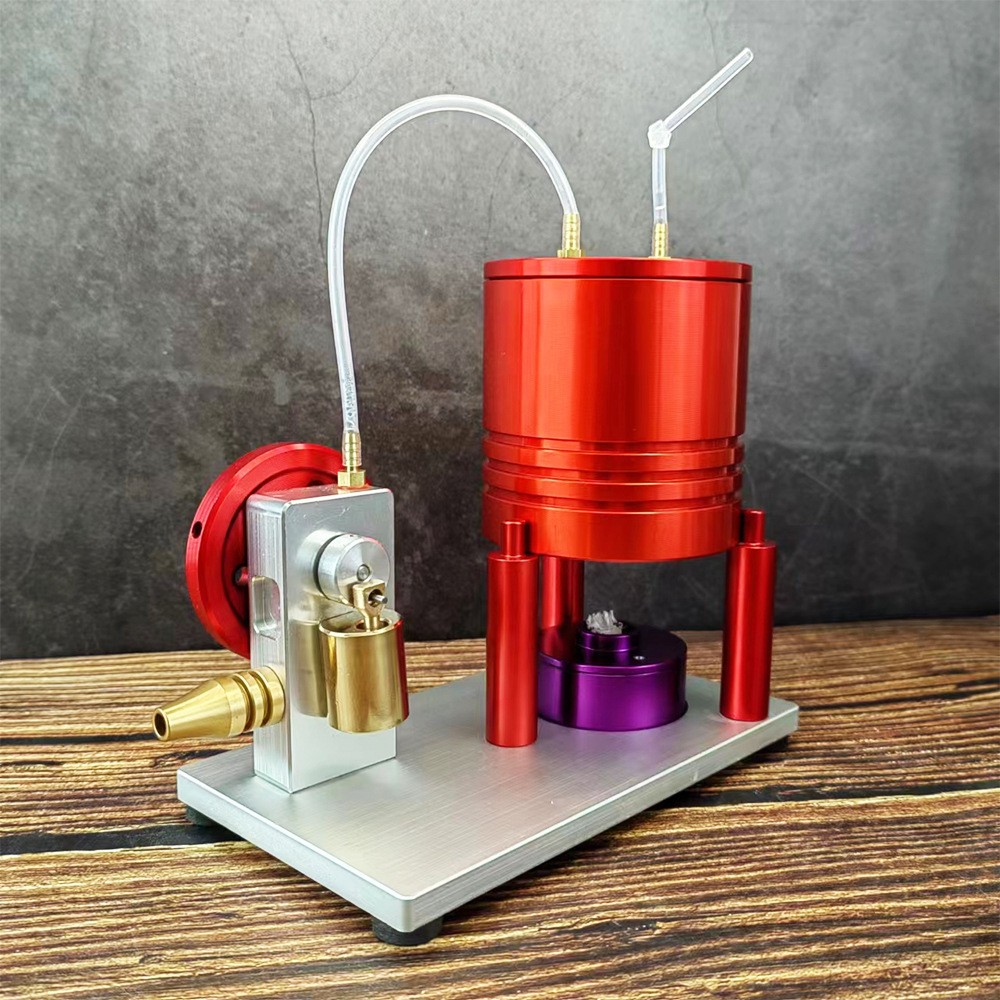
Two options: the all-metal Stirling engine generator with its own alcohol burner, and the compact hot-air Stirling science kit that lights an LED through its generator.
When Should You Choose a Steam Engine Model?
- You love the look and sound of real steam.
- You are interested in railway, marine or industrial history.
- You want a collectible display piece in brass and coloured metal.
- You can give the engine your full attention while it runs.
If engine history is what draws you in, the aircraft engines that followed steam are just as interesting: read how a radial engine works.
Which Is Safer?
Neither is a toy for unsupervised children. Both use an open flame and both get hot enough to burn. A steam engine adds two more hazards: hot steam, and a boiler that must never be allowed to run dry over a flame. A Stirling engine has no pressurised steam, which makes it the easier choice for a classroom demonstration, but it still needs an adult in charge.
Safety note: Both models use an open flame and get hot. Adult use or supervision is required. Fuel (alcohol) is not included and cannot be shipped. Run the engine on a stable, heat-resistant surface away from paper and fabric, and let it cool fully before touching, refilling or packing it away.
What Fuel Do These Engines Use?
Both burn liquid alcohol in a small burner or spirit lamp. The Stirling generator model asks for alcohol of 95% purity or more. Check the manual for your engine, buy the fuel locally, and never use petrol, lighter fluid or other fuels the manufacturer does not list.
Key Takeaways
- Both are external combustion engines heated by an alcohol flame.
- A Stirling engine reuses sealed air; a steam engine boils water and releases the steam.
- Stirling models are quieter and need less preparation; steam models give you real steam and more history.
- Steam engines add hot steam and boiler care to the safety checklist.
- For a classroom, start with a Stirling engine. For a collector who loves steam, choose the steam engine.
FAQ
Which is better for a science classroom?
A Stirling engine, usually. It shows heat turning into motion without pressurised steam, and generator versions show heat becoming electricity. An adult must still supervise the flame.
Does a Stirling engine need water?
No. It runs on sealed air that is heated and cooled again and again. Only the burner needs refilling.
Why does a model steam engine stop after a while?
The boiler runs low on water. Put out the flame before the water runs out, let the engine cool, and refill it before the next run.
Can children use these engines?
Only with an adult in charge. Both use an open flame and have hot surfaces, and the steam engine also produces hot steam.


