How Does a Stirling Engine Work? The Hot-Air Engine Explained
How a Stirling engine turns heat into motion: the closed air cycle, the displacer, the regenerator, the three engine layouts, and how desktop models run.

A Stirling engine is a closed-cycle heat engine. It seals a fixed amount of air (or another gas) inside, heats one end and cools the other, and moves that air back and forth between the two. The air expands when it is hot and contracts when it is cool, and the changing pressure pushes a piston that turns a flywheel. No fuel burns inside the engine, so any outside heat source can run it.
This guide explains the Stirling cycle step by step, the parts that make it work, the three classic layouts, and what to expect from a desktop Stirling engine model. It is written for curious builders and for teachers who want to show thermodynamics working in front of a class.
What Is a Stirling Engine?
The Stirling engine is a type of external combustion engine: the heat is applied to the outside of a cylinder, and the gas that does the work never leaves the engine. A petrol engine is the opposite. It burns fuel inside the cylinder and pushes the exhaust out after every cycle.
Robert Stirling, a Scottish clergyman and engineer, patented his “air engine” in 1816. His patent also described an “economiser”, the heat store we now call the regenerator. According to the Wikipedia biography of Robert Stirling, a 2 hp engine built to his design was pumping water at a quarry in Ayrshire by 1818.
Because the gas is sealed in, a Stirling engine has no intake, no exhaust and no explosions. That makes it unusually quiet, and it lets the engine run on a candle, a spirit lamp, sunlight, or the warmth of a cup of coffee in the case of very low temperature models.
How Does a Stirling Engine Work, Step by Step?
Every Stirling engine repeats the same four-stage cycle. The description below uses a displacer-type engine, the layout used by most desktop models.
- Heating. The displacer moves the air to the hot end of the cylinder. The air absorbs heat, and its pressure rises.
- Expansion. The high-pressure air pushes the power piston outward. This is the stroke that does useful work and spins the flywheel.
- Cooling. The displacer shifts the air to the cold end. The air gives up heat to the cooler side, and its pressure drops.
- Compression. The flywheel’s momentum pushes the power piston back in against the low-pressure air, which takes less work than the expansion stroke produced. The cycle then starts again.
The engine makes power because the expanding hot air pushes harder than the contracting cool air resists. The difference between the two is the net work that keeps the flywheel turning.
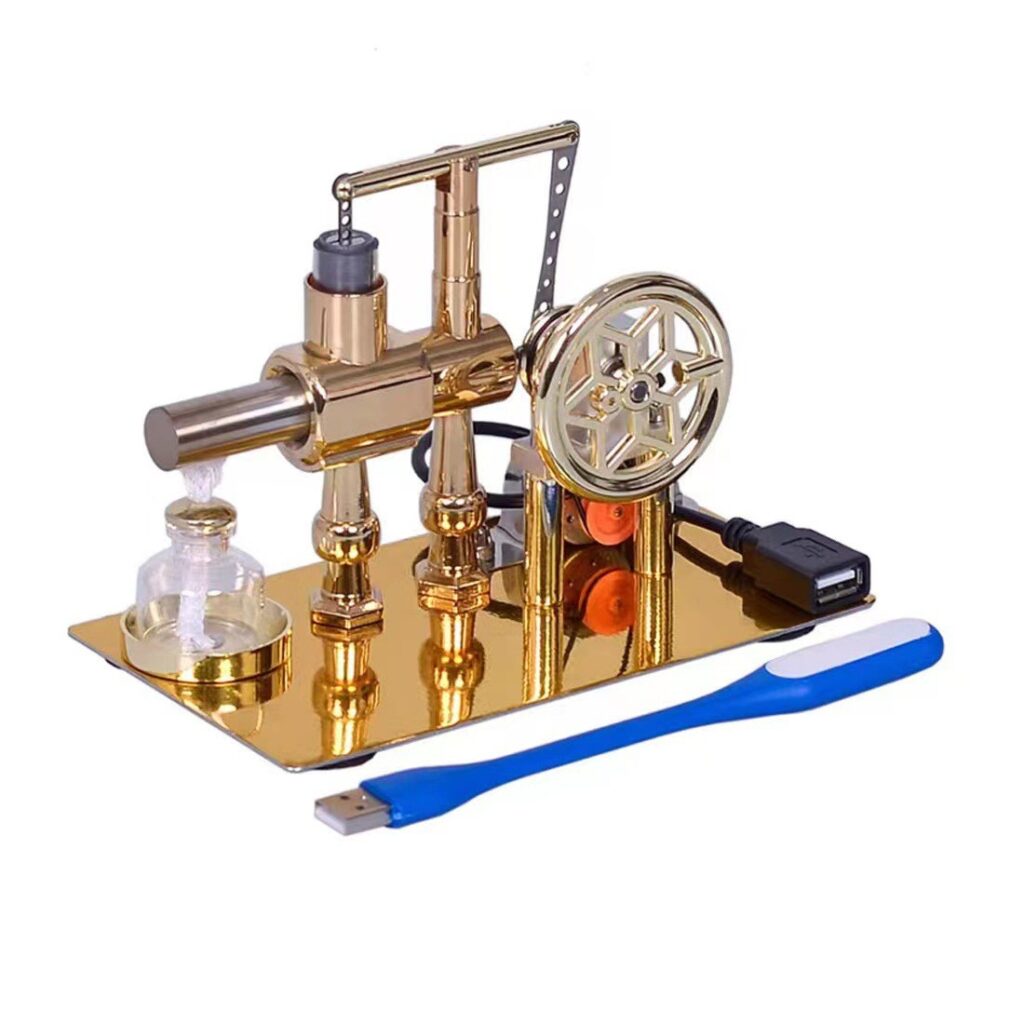
What Are the Main Parts of a Stirling Engine?
| Part | What it does |
|---|---|
| Hot end | Takes in heat from the flame, sunlight or another source. |
| Cold end | Releases heat to the air, often through cooling fins. |
| Displacer | A loose-fitting piston that shuttles the air between the hot and cold ends. It does not produce power itself. |
| Power piston | A tight-fitting piston that the changing gas pressure pushes in and out. |
| Regenerator | A heat store in the air path. It absorbs heat from air moving to the cold end and gives it back on the way to the hot end, so less heat is wasted. |
| Flywheel and crank | Turns the back-and-forth motion into rotation and keeps the displacer and piston about a quarter turn (90°) apart. |
The regenerator is what separates a true Stirling engine from other hot-air engines. The Wikipedia article on the Stirling engine describes it as the component that keeps heat inside the machine instead of dumping it into the cold side. Simple desktop models often rely on the gap around the displacer to do this job.
Alpha, Beta and Gamma: What Are the Three Stirling Layouts?
Engineers group Stirling engines into three layouts by how the pistons are arranged.
| Layout | Arrangement | Where you see it |
|---|---|---|
| Alpha | Two power pistons in two separate cylinders, one hot and one cold. No displacer. | Higher-power engines |
| Beta | Displacer and power piston share one cylinder. | Robert Stirling’s original design; compact engines |
| Gamma | Displacer in one cylinder, power piston in a second, smaller cylinder. | Many desktop and educational models |
For a model on your desk, the layout matters less than the build quality. A smooth, low-friction piston and a well-balanced flywheel decide whether the engine runs for minutes or for hours on a single burner fill.
Why Does Temperature Difference Matter?
A Stirling engine runs on the temperature difference between its hot and cold ends, not on heat alone. The bigger the difference, the more work it can extract from each cycle. NASA’s Glenn Research Center page on the Carnot cycle explains the underlying rule: the maximum possible efficiency of any heat engine depends only on the temperatures of its heat source and heat sink.
This explains two things you notice on a desktop model. The engine speeds up as the hot end warms over the first minutes, and it slows down if the cold end heats up too, for example in a warm room or after a long run.
Where Are Stirling Engines Used Today?
Stirling engines never replaced steam or petrol engines for everyday power, but their silence and fuel flexibility found niche uses:
- Submarines. Sweden’s Gotland-class submarines were the first to use a Stirling engine air-independent propulsion system. It lets them stay submerged for weeks instead of days.
- Spacecraft power. NASA’s Glenn Research Center developed the Advanced Stirling Radioisotope Generator, which needed about one quarter of the plutonium-238 of earlier generators for the same power. The flight contract was cancelled in 2013, but Stirling converter testing continued.
- Cars, briefly. A NASA and US Department of Energy programme that began in 1978 fitted a Stirling engine to a 1985 Chevrolet Celebrity, which recorded 32% better fuel economy than the factory car. It never went into production.
- Cooling. Run backwards, a Stirling machine becomes a heat pump. Stirling cryocoolers are used to chill sensors and scientific instruments.
How Do Desktop Stirling Engine Models Work?
A desktop model is a small, working Stirling engine, usually heated by an alcohol burner. Most are not self-starting. You light the burner, wait a minute or two for the hot end to warm up, then give the flywheel a gentle spin. If the temperature difference is large enough, the engine keeps running on its own.
Some models add a small generator so you can see heat become electricity. The Stirling engine generator model is all metal, measures 165 × 95 × 130 mm and comes with its alcohol burner. The more compact hot-air Stirling engine science kit (150 × 85 × 95 mm) uses its generator to light an LED, which makes the energy conversion easy to see in a classroom.
Safety note: Desktop Stirling engines use an open flame and get hot. Adult supervision is required. Both models above run on high-purity alcohol (95% or more), which is not included and cannot be shipped. Let the engine cool completely before you touch the hot end or refill the burner.
If the engine will not keep running
- Give the hot end more time to warm up before you spin the flywheel.
- Check that the flame actually touches the hot end and is not blown sideways by a draught.
- Spin the flywheel in the other direction. Many models run one way only.
- Look for friction: the flywheel should coast freely when the engine is cold.
Curious how a Stirling engine compares with a model steam engine? Read Stirling Engine vs Steam Engine Model: Which Should You Buy?. For an engine that burns its fuel inside the cylinders, see how a radial engine works.
Key Takeaways
- A Stirling engine seals in a fixed amount of gas and runs it through a cycle of heating, expansion, cooling and compression.
- Heat comes from outside the engine, so any heat source works and the engine is very quiet.
- The displacer moves the air; the power piston does the work; the regenerator saves heat between cycles.
- Power depends on the temperature difference between the hot and cold ends.
- Desktop models usually need a warm-up and a gentle push on the flywheel to start.
FAQ
Who invented the Stirling engine?
Robert Stirling, a Scottish clergyman and engineer, patented the engine in 1816. He later developed it further with his brother James Stirling.
Is a Stirling engine an internal or external combustion engine?
It is an external combustion engine. The heat is applied to the outside of the cylinder and the working gas stays sealed inside, so no fuel burns in the cylinder.
Why does my Stirling engine need a push to start?
Most small Stirling engines are not self-starting. The flywheel needs a spin to begin the cycle; after that, the temperature difference keeps it going.
Can a Stirling engine run on sunlight or body heat?
Yes, if the engine is designed for it. Low temperature difference models can run on a warm hand or a hot drink, and large solar Stirling engines use concentrated sunlight. Standard desktop models need a flame.
Why are Stirling engines not used in cars?
They take time to warm up, change speed slowly and cost more to build than petrol engines of the same power. A Stirling-powered test car showed better fuel economy in 1985, but the design was never put into production.


